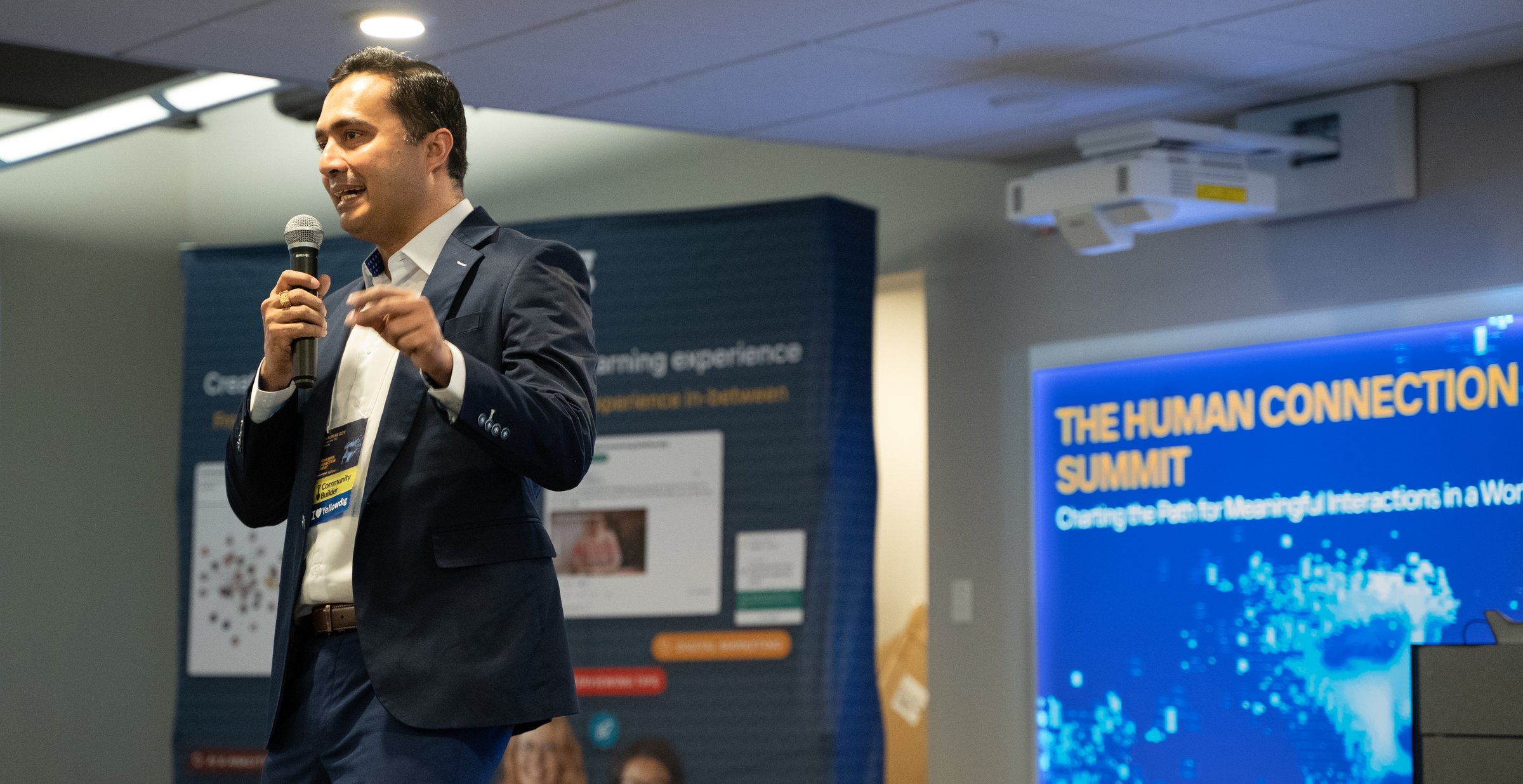
Connecting the dots. A decade of building toward the whole human in education.
How someone who never much liked sitting in a classroom ended up spending a career trying to redesign one. What I believed early, what ten years of data has taught me since, and why I think community rather than content is the part of education worth defending.
01 · The openingThe boy who was never a first-bencher
The thing to know about me first is that I did not grow up loving school. I loved learning. I have come to think those are two fairly different things, and that a good deal of what is broken in education comes from confusing them.
I was asked about my childhood in an interview a few years ago, and this is how I answered it:
"Growing up, I wasn't the typical 'first-bencher' in school. I was the inquisitive tinkerer, crafting handmade gifts for my sister. Despite not conforming to traditional learning norms, I fell in love with learning's adventurous and curious nature. This passion propelled me to excel at institutions like the Indian Institute of Technology and the Massachusetts Institute of Technology. However, it was the joy of learning that truly steered me toward creating Yellowdig — an endeavor to make inquiry-driven learning accessible at scale, rekindling the spark in learners regardless of age or background." EdTech Digest, September 2023
I did not see it at the time, but most of what Yellowdig eventually became is sitting in that answer. School had a fairly clear picture of what a good student looked like and I did not match it. I was the one at the back taking things apart. That never stopped me from loving the material, and eventually it carried me through IIT Bombay and MIT, which are not places you coast through. But the love of learning and the experience of school were running on separate tracks for me, and I have never quite lost the sense that the classroom was accidentally leaving out a lot of people who were perfectly capable of the work.
Most of what follows here is an attempt to work on that problem in public.
02 · The fearThe fear at the back of the room
What I do not usually mention alongside IIT and MIT is that getting into those places did very little for the underlying anxiety. I wrote about this fairly directly in a newsletter essay in late 2024:
"Growing up in India, I had a complex relationship with education. Given the country's population of 1.4 billion and hundreds of millions of school-aged students, securing a quality education felt like winning the lottery, and I took it seriously. I loved learning but didn't particularly enjoy sitting in a classroom. One of my greatest fears was being called on in class — I worried I'd say something wrong and face ridicule. Although school provided great friendships and fun experiences, it couldn't shield me from the anxiety of being singled out or the pressure of failing a test." Education 3.0 (LinkedIn), November 2024
I mention it because I do not think I was unusual in this. The fear had very little to do with whether I had done the reading. It came from the structure of the room. A traditional class asks a student to think out loud, on the spot, in front of everyone, and it makes the cost of being wrong both public and durable. Some students find that energizing. A great many do not, and we tend to read their silence as disengagement when a lot of the time it is self-protection.
What I would say now is that this is a design problem rather than a character problem. We built rooms in which being visibly uncertain is expensive, and then we are surprised that participation is thin. Several of the decisions we made in Yellowdig, the asynchronous format in particular, come fairly directly out of that observation.
03 · The deferred decadeA decade deferred, and the moment the door opened
There is usually a gap between the point at which a founder knows what they want to build and the point at which they are actually able to build it. Mine ran about ten years.
I came to the United States from India on a student visa. Staying after graduate school meant finding an employer willing to sponsor me, which in practice meant consulting or a large corporation rather than the company I had already started imagining. So I took the conventional route, largely because it was the only route available. I spent that decade at Booz & Company, then KPMG, and finally at FMC Corporation as a director of strategy, where I ran business development and built a new business division inside a five billion dollar public company. It was useful training and I was restless for most of it.
Ability to start something on my own after 10 years in the country changed the arithmetic. I left, took a desk in a coworking space in Philadelphia, found a technical co-founder, and in the spring of 2014 we piloted the first version of Yellowdig in three MBA classes at Wharton and an engineering class at MIT. The company launched properly the following year.
Early trade coverage described us as Reddit for the classroom, which was fair enough at the time and is a useful marker of how far things have moved. We began as a discussion experience for a single course. The platform now covers the whole learner lifecycle, from before a student enrolls through to alumni.
04 · The insightThe insight that became Yellowdig
Discussion boards had already been built, and they had already failed. The question worth asking was why.
By the time I started Yellowdig, every major learning management system on the market shipped with a discussion board, and none of them produced much real student-to-student conversation. My conclusion was that the feature was not the problem. The category was.
"Learning management systems are primarily used for managing course content. LMSes do offer discussion boards, but it is primarily used for discussion assignments as opposed to building true learning communities." Inside Higher Ed, February 2021
If you ask a content management system to host a community, what you get is something that looks like a community and behaves like an assignment. What I wanted to build started from social interaction rather than from content, and borrowed what consumer platforms had worked out about feeds, participation, recognition and reciprocity, then pointed those mechanics at academic outcomes instead of at attention.
I am also particular about one word here. Yellowdig is gameful, not gamified. Gamification usually means attaching rewards to an experience that is not motivating on its own, and students see through that quickly. Gameful design means treating motivation as an engineering problem: building the conditions in which agency, mastery and connectedness reinforce one another, and letting the visible mechanics recede as intrinsic motivation takes over.
05 · The frameworkA pedagogy in three words: agency, mastery, connectedness
One framework comes up in nearly every conversation I have, and it has been the same three words for years now.
Agency
The learner has real choice about what to engage with, how to engage, and where to go next. Take that away and participation turns into compliance, which is not the same thing as learning.
Mastery
The learner can see themselves getting better at something they care about. That requires feedback and some visible sense of progress from where they started.
Connectedness
The learner is known by other people working on the same thing. In my experience this is the piece that most often determines whether a student stays.
"We often advise our clients to carefully consider student agency, mastery and connectedness when designing their online experiences. These aspects are deeply rooted in the learner's motivational factors, making learning both joyful and productive." Inside Higher Ed, June 2024
The three principles come out of Self-Determination Theory, the work Edward Deci and Richard Ryan developed over several decades, though I spend more time on how to operationalize it than on the citation. The claim I keep making, in podcasts and on conference stages and in the newsletter, is that these are designable and measurable properties of a course rather than a matter of an instructor's charisma. I think that distinction matters quite a lot, because charisma does not scale and design does.
06 · The reframeDesign, not delivery: the wrong debate in higher ed
Higher education has spent most of the last decade arguing with itself about modality. Online or in person. Synchronous or asynchronous. Hybrid or residential. The pandemic made the argument louder without making it more useful, and most of the academic leaders I talk to are tired of it, mainly because the framing hands them nothing they can act on when they get back to their faculty and their students. I have used most of the platforms available to me to try to move the question somewhere more productive.
"The mode of course delivery — whether online, offline, or hybrid — has less to do with its impact on the learner's mental health than the design of the learning experience. Sitting in a lecture hall does not inherently lead to more human connections and a sense of belonging, just as an online course is not inherently devoid of connections." Inside Higher Ed, June 2024
Where the learning happens matters considerably less than how it was designed. A badly designed in-person course can be one of the loneliest experiences a young adult goes through, and a well designed online course can be one of the most connected they have. I have not yet seen the evidence point the other way.
"This approach makes instructional design and delivery more akin to engineering than merely creating a pretty classroom or website." Inside Higher Ed, June 2024
In work with the Australian provider OES, programs that designed deliberately for community saw pass rates rise by an average of nine percent, and seven percent more students carried on into their next study period. Nothing had changed about the content. What changed was the connection.
07 · The evidenceA decade of validation, from students, educators, administrators, and data
A founding insight is really just a hypothesis. Ten years and tens of thousands of courses later, I think it has held up.
The main thing I would claim over most people writing about education technology is that I have had to test these ideas against audiences that push back: real students, real faculty, real administrators, and a large and fairly messy body of data about how learning actually behaves at scale. I have shipped, watched things go wrong, and revised, a number of times.
The most complete version of what that decade taught me is a book chapter I wrote with Dr. Brian N. Verdine of the University of Delaware's School of Education, Hybrid Learning Across Time and Space. It draws on what we have observed across tens of thousands of courses using gameful, community-driven design, and it argues that authentic human connection is not a soft addition to learning but the structure that holds the rest of it up. Connection keeps students and instructors motivated, it improves course progression, and it increases the time students actually spend with the material.
The chapter has been endorsed by three people whose judgment carries weight in higher-education leadership:
The numbers from outside Yellowdig are not encouraging. Gallup has put high-school student engagement at around 60 percent, and among college students it sits below half and tends to keep sliding from there. We have spent decades treating that as a content problem. Treating it as a community and design problem is comparatively new at the level of institutional strategy, and so far it is the version the evidence keeps supporting.
One of our customers looked at what predicted whether students would recommend their program. The strongest predictor was not academic rigor, or the institution's brand, or the delivery mode. It was whether the student felt a sense of belonging with other students, with instructors, and with administrators. That finding has stayed with me.
08 · The whole humanThe whole human: an anti-reductionist case for education
Education is not a content-delivery pipeline. It never really was, and in an economy being reshaped by AI, continuing to treat it as one is becoming actively risky.
This is the argument I have pushed hardest in the Education 3.0 newsletter, and particularly in a March 2024 essay called Whole Human: An Anti-Reductionist Approach to Education and Student Success.
I open that essay with a number I find hard to get past. Research from the Strada Education Foundation and the Burning Glass Institute found that 52 percent of college-educated graduates are underemployed a year after finishing, working in jobs that do not require the degree they earned. Only about one in ten of them find college-level work within ten years. Meanwhile the useful life of a specific technical skill has fallen below five years in most fields, and to roughly two and a half years in the faster-moving parts of technology. A system built mainly to transfer a finite set of marketable skills is failing most of the students it takes money from, and AI is speeding that failure up.
I try to be careful not to lay this at the feet of faculty or institutions. Teaching has become close to heroic work, the expectations placed on educators have been unreasonable, and a good deal of what still goes right inside classrooms happens because instructors are quietly absorbing pressure that no individual should be asked to absorb. My argument is about purpose rather than effort. I think we have misunderstood what the thing is for.
"Education cannot merely function as a machine for transferring knowledge and skills — AI bots and robots will soon fill that role. Instead, it should transform learners into better versions of themselves. Transformation cannot be forced or controlled; it must stem from the students themselves." Education 3.0 (LinkedIn), November 2024
The alternative I argue for is what I call whole human development:
"Whole human development advocates for a learner-centric approach, treating learners as whole humans with empathy, giving them a voice, and encouraging them to bring their full selves into the learning environment. This approach goes beyond merely transferring a set of skills; it engages learners in an authentic manner." Education 3.0 (LinkedIn), March 2024
To make it concrete I often borrow a question from David Daniels, one of Yellowdig's board members. Do you remember your favorite teacher? Almost everyone does. And what we remember is hardly ever the content they covered. We remember being seen by them, and that they cared about us in a way that went past the syllabus. That is the standard I think we should be designing toward.
The Swiss watch and the secret of relatedness
The other example I keep coming back to is from my own engineering education. Suppose you are teaching the science behind a watch. One group of students learns the physics. Another group learns how a Swiss watch is actually made, which means the design decisions, the craftsmanship, the engineering, the centuries of accumulated tradition and the people who carried it forward. Both groups are studying the same science. Only the second group is studying it in a way that engages their imagination and gives them a reason to keep going. The science is identical. What differs is relatedness, the sense that the material belongs to a larger human story the learner is being invited into.
Durable skills, not disposable ones
"Employers are increasingly valuing durable skills: communication, critical and creative thinking, collaboration, problem-solving, and the capacity for lifelong learning. Specific skills are important, but they won't single-handedly defend against the onslaught of AI." Education 3.0 (LinkedIn), March 2024
Durable skills grow in human company. You cannot transmit them through a video and a chatbot cannot hand them to you. They happen to be exactly the things AI will not do on your behalf, which is why I think a community-centered education is the practical response to AI rather than a sentimental one.
09 · The frontierEducation 3.0: what AI changes, and what it cannot
Generative AI has unsettled most of the assumptions about how learning works at scale. Content can be produced on demand, tutoring can be personalized and effectively unlimited, and a good deal of assessment can be automated. Many people in the sector have concluded from this that the role of the human educator is shrinking. That conclusion is generating real anxiety inside institutions, among faculty who are not sure their craft is still valued, among administrators whose staffing models suddenly look uncertain, and among students who are asking what exactly they are paying for. I take that anxiety seriously. I have come to the opposite conclusion about where AI leaves us.
"As AI increasingly handles content delivery, the uniquely human work of education shifts toward community architecture. The future instructor is less a broadcaster of knowledge and more a designer of learning ecosystems." Yellowdig blog, December 2025
What AI actually does is take away the work that machines were always going to be better at, and force a long overdue conversation about what is left. AI can deliver information. It cannot make meaning with someone. It can answer a question well. It cannot help a nineteen-year-old work out, in the company of peers and a mentor who knows them, who they are turning into.
"Education 3.0 isn't about replacing humans with machines. It's about creating spaces where humans can do what machines cannot: make meaning together." Yellowdig blog, December 2025
10 · The platformFrom classroom tool to lifecycle platform
For its first several years Yellowdig was understood, reasonably enough, as a classroom community product. Faculty added it to a course, students participated for credit, and the conversation moved out of the LMS discussion board into something that behaved more like a community. It worked and it scaled. But I had become convinced that we were looking at the wrong unit of analysis.
A student does not really belong to a course. They belong to a program, a cohort, an institution, a period of their life. The relationships that determine whether they persist and graduate start forming well before the first day of class, and they keep mattering long after any single course has ended. Over the past two years we have built out three pillars that follow the learner across that whole arc:
Connect
Pre-enrollment, orientation and the earliest part of the journey, which is the work of welcoming students into a community before they ever reach a classroom. Anchored by our 2025 acquisition of GetSet Learning.
Engage
The classroom community product we are best known for. Gameful, asynchronous, and designed for the student-to-student exchange that an LMS discussion board has never managed to produce.
Succeed
Persistence, retention and the lifecycle work of getting students to graduation. In 2026 we became the first company in our category to put a guarantee behind a retention outcome, committing publicly to raising customer retention by at least one percentage point.
11 · The thesisConnecting the dots
If I had to reduce what I think education is for to a single sentence, it would be that learning is the slow work of connecting the dots.
The dots are personal and professional. Old interests and new ones. Failures that cost something, and small recognitions that arrived at the right moment. An idea from one field that suddenly explains a problem in another. Mentors, friends, and strangers whose questions change the way you think. A course you took at twenty that finally makes sense at forty-five. A childhood habit of taking things apart which turns out, decades later, to have been the point.
The skills that hold their value across a working life are not the rote ones, because AI is already faster, cheaper and considerably more patient at those than any of us will be. The durable ones are connective: communication, critical and creative thinking, collaboration, problem-solving, and the capacity to keep learning. They come out of being around other people rather than out of content delivery.
This is also where I land on technology itself. Used carelessly it reduces things. It flattens, it standardizes, and it optimizes for whatever is easiest to measure. Used deliberately it is the best infrastructure we have ever had for building human community at scale. We built Yellowdig to be the second kind, and I am aware that intent on its own does not guarantee it.
12 · The personal noteWhat I tell my daughters
I do not write about my family very often. But I have two daughters, and the conversations we have at our kitchen table are probably the honest test of everything above.
"What I tell my daughters — and what I believe every learner deserves to be told — is that the point of their education is not only to succeed. Success is part of it. So is their mental health. So is fulfillment. So is the courage to know themselves well enough to choose work that means something to them, and to refuse work that does not. So is the willingness to live a full life, not only a productive one.
Achievement matters. But achievement without belonging, without meaning, without the people who hold us through the hard parts — that is a thin thing. My daughters deserve more than that. The students whose names I will never know deserve more than that. The educators who have given their professional lives to those students deserve to be supported in building more than that. That is what Yellowdig was built for."
The mission is not abstract to me. Every learner, mine included, should be able to walk into a course and find a design that takes their nervousness seriously, hands them some control over their own learning, helps them find the people who will end up teaching them as much as any instructor does, and prepares them for a life rather than only for a career.
13 · The invitationIf this resonates
If you have read this far, you probably recognize these questions because they are live on your own campus. Completion. Student mental health. What online learning is really for. What an AI-saturated future asks of human educators. What the institution is actually for.
I know how hard this work is at the moment. A lot of you are holding institutions together through enrollment pressure, financial pressure, a student mental-health picture that keeps getting worse, and an AI conversation that changes shape every quarter. I do not take for granted that you spent any of that time on a page about me. If you take one thing away from it, I would want it to be that the work you are doing matters, and that it is not yours to do alone.
If any of this connects to what you are working through, my team and I would be glad to think it through with you. Get in touch ↓